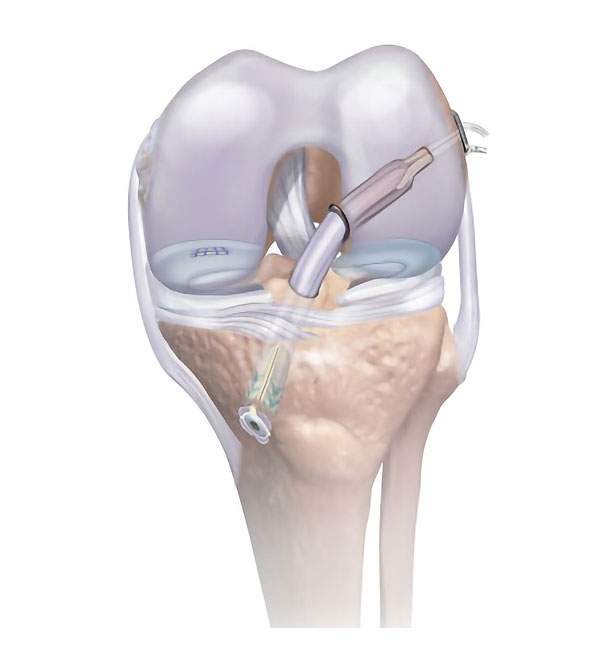
The new ligament (graft) is typically taken from a donor site from another part of your knee, called an autograft. The three main graft options are using the patellar tendon, hamstring tendons, and quadriceps tendon. All options have been shown to be successful in restoring knee stability and getting patients back to sports. Each have their advantages and disadvantages.
The patellar tendon graft has been shown to have a lower re-tear rate compared to a hamstring graft and may provide more stability. Because of this, it is often the graft of choice for younger athletes who participate in pivoting and contact sports. However, patients typically experience more pain immediately after surgery. There is also a higher risk of long-term pain in the front of the knee around the kneecap, which can lead to difficulty kneeling. This can be problematic for patients that work as labourers or enjoy activities such as yoga.
Patients who have a hamstring graft typically have less pain immediately after surgery. There is also less chance of pain at the front of the knee or difficulty kneeling. However, it is associated with higher risks of re-tear compared to patellar tendon grafts.
The quadriceps tendon graft has gained popularity due to its decreased re-rupture rate compared to a hamstring graft and decreased risk of anterior knee pain compared to a patellar tendon graft. It can take longer to regain quadriceps strength immediately after surgery.
Overall, all graft options have been shown to lead to excellent results. The decision should be made on an individual basis and after discussion with your surgeon.
Using a donor tendon (allograft) is generally not recommended as there is a significantly higher risk of re-tear compared to using an autograft. Allograft is occasionally used for revision surgery or older patients.